Khóa học
IELTS Online
IELTS Online
Giảm đến 18%
Đăng ký ngay
Mục lục [Ẩn]
Bài Driverless Cars IELTS Reading mang đến cái nhìn toàn diện về sự phát triển của xe tự lái – một trong những bước tiến công nghệ nổi bật nhất trong lĩnh vực giao thông hiện đại. Thông qua bài đọc này, bạn không chỉ rèn luyện kỹ năng đọc hiểu theo dạng Matching headings, Summary completion hay Multiple choice, mà còn mở rộng vốn từ vựng học thuật về công nghệ và môi trường – hai chủ đề thường xuyên xuất hiện trong IELTS Reading.
A. The automotive sector is well used to adapting to automation in manufacturing. The implementation of robotic car manufacture from the 1970s onwards led to significant cost savings and improvements in the reliability and flexibility of vehicle mass production. A new challenge to vehicle production is now on the horizon and, again, it comes from automation. However, this time it is not to do with the manufacturing process, but with the vehicles themselves.
Research projects on vehicle automation are not new. Vehicles with limited self-driving capabilities have been around for more than 50 years, resulting in significant contributions towards driver assistance systems. But since Google announced in 2010 that it had been trialling self-driving cars on the streets of California, progress in this field has quickly gathered pace.
B. There are many reasons why technology is advancing so fast. One frequently cited motive is safety; indeed, research at the UK's Transport Research Laboratory has demonstrated that more than 90 percent of road collisions involve human error as a contributory factor, and it is the primary cause in the vast majority. Automation may help to reduce the incidence of this.
Another aim is to free the time people spend driving for other purposes. If the vehicle can do some or all of the driving, it may be possible to be productive, to socialise or simply to relax while automation systems have responsibility for safe control of the vehicle. If the vehicle can do the driving, those who are challenged by existing mobility models – such as older or disabled travellers – may be able to enjoy significantly greater travel autonomy.
C. Beyond these direct benefits, we can consider the wider implications for transport and society, and how manufacturing processes might need to respond as a result. At present, the average car spends more than 90 percent of its life parked. Automation means that initiatives for car-sharing become much more viable, particularly in urban areas with significant travel demand. If a significant proportion of the population choose to use shared automated vehicles, mobility demand can be met by far fewer vehicles.
D. The Massachusetts Institute of Technology investigated automated mobility in Singapore, finding that fewer than 30 percent of the vehicles currently used would be required if fully automated car sharing could be implemented. If this is the case, it might mean that we need to manufacture far fewer vehicles to meet demand. However, the number of trips being taken would probably increase, partly because empty vehicles would have to be moved from one customer to the next.
Modelling work by the University of Michigan Transportation Research Institute suggests automated vehicles might reduce vehicle ownership by 43 percent, but that vehicles' average annual mileage double as a result. As a consequence, each vehicle would be used more intensively, and might need replacing sooner. This faster rate of turnover may mean that vehicle production will not necessarily decrease.
E. Automation may prompt other changes in vehicle manufacture. If we move to a model where consumers are tending not to own a single vehicle but to purchase access to a range of vehicle through a mobility provider, drivers will have the freedom to select one that best suits their needs for a particular journey, rather than making a compromise across all their requirements.
Since, for most of the time, most of the seats in most cars are unoccupied, this may boost production of a smaller, more efficient range of vehicles that suit the needs of individuals. Specialised vehicles may then be available for exceptional journeys, such as going on a family camping trip or helping a son or daughter move to university.
F. There are a number of hurdles to overcome in delivering automated vehicles to our roads. These include the technical difficulties in ensuring that the vehicle works reliably in the infinite range of traffic, weather and road situations it might encounter; the regulatory challenges in understanding how liability and enforcement might change when drivers are no longer essential for vehicle operation; and the societal changes that may be required for communities to trust and accept automated vehicles as being a valuable part of the mobility landscape.
G. It's clear that there are many challenges that need to be addressed but, through robust and targeted research, these can most probably be conquered within the next 10 years. Mobility will change in such potentially significant ways and in association with so many other technological developments, such as telepresence and virtual reality, that it is hard to make concrete predictions about the future. However, one thing is certain: change is coming, and the need to be flexible in response to this will be vital for those involved in manufacturing the vehicles that will deliver future mobility.
Questions 14-18
Reading Passage 2 has seven paragraphs, A-G.
Which section contains the following information?
14. reference to the amount of time when a car is not in use...............
15. mention of several advantages of driverless vehicles for individual road-users...............
16. reference to the opportunity of choosing the most appropriate vehicle for each trip...............
17. an estimate of how long it will take to overcome a number of problems...............
18. a suggestion that the use of driverless cars may have no effect on the number of vehicles manufactured...............
Questions 19-22
Complete the summary below.
Choose NO MORE THAN TWO WORDS from the passage for each answer.
The impact of driverless cars
Figures from the Transport Research Laboratory indicate that most motor accidents are partly due to 19................, so the introduction of driverless vehicles will result in greater safety. In addition to the direct benefits of automation, it may bring other advantages. For example, schemes for 20................ will be more workable, especially in towns and cities, resulting in fewer cars on the road.
According to the University of Michigan Transportation Research Institute, there could be a 43 percent drop in 21................ of cars. However, this would mean that the yearly 22................ of each car would, on average, be twice as high as it currently is. this would lead to a higher turnover of vehicles, and therefore no reduction in automotive manufacturing.
Questions 23 and 24
Choose TWO letters, A-E.
Which TWO benefits of automated vehicles does the writer mention?
Questions 25 and 26
Choose TWO letters, A-E.
Which TWO challenges to automated vehicle development does the writer mention?
>> Xem thêm:
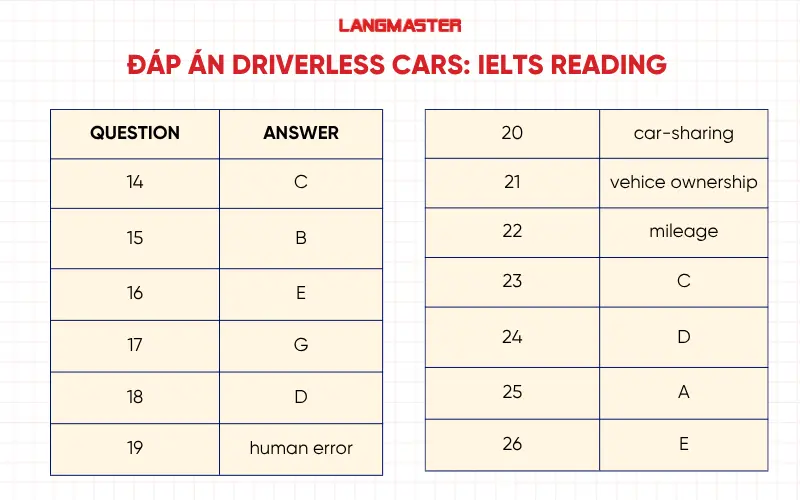
Questions 14-18
14. reference to the amount of time when a car is not in use...............
Thông tin: “At present, the average car spends more than 90 percent of its life parked.”
Giải thích: Câu này cho biết trung bình mỗi chiếc xe hơi dành hơn 90% thời gian để đỗ, tức là không được sử dụng. → Điều này trực tiếp trả lời cho ý hỏi “thời gian xe không được dùng đến”.
=> Đáp án: C
15. mention of several advantages of driverless vehicles for individual road-users...............
Thông tin:
Giải thích: Đoạn B liệt kê nhiều lợi ích cá nhân mà xe tự lái mang lại:
=> Đáp án: B
16. reference to the opportunity of choosing the most appropriate vehicle for each trip...............
Thông tin: “Drivers will have the freedom to select one that best suits their needs for a particular journey, rather than making a compromise across all their requirements.”
Giải thích: Câu này mô tả viễn cảnh khi người dùng không sở hữu xe riêng, mà chọn loại xe phù hợp cho từng chuyến đi (ví dụ: xe nhỏ cho di chuyển cá nhân, xe lớn cho chuyến đi gia đình). → Hoàn toàn khớp với yêu cầu “cơ hội chọn xe phù hợp nhất cho từng chuyến đi”.
=> Đáp án: E
17. an estimate of how long it will take to overcome a number of problems...............
Thông tin: “Through robust and targeted research, these can most probably be conquered within the next 10 years.”
Giải thích: Câu này đưa ra ước tính thời gian – khoảng 10 năm – để giải quyết các thách thức của xe tự lái (kỹ thuật, pháp lý, xã hội...).
→ Đáp ứng chính xác yêu cầu của câu hỏi: “ước lượng thời gian khắc phục các vấn đề”.
=> Đáp án: G
18. a suggestion that the use of driverless cars may have no effect on the number of vehicles manufactured...............
Thông tin: “Each vehicle would be used more intensively, and might need replacing sooner. This faster rate of turnover may mean that vehicle production will not necessarily decrease.”
Giải thích: Mặc dù số lượng xe sở hữu cá nhân có thể giảm, nhưng vì xe tự lái được sử dụng nhiều hơn và cần thay thế sớm hơn, nên tổng lượng xe sản xuất hàng năm có thể không giảm. → Điều này chính là “việc sử dụng xe tự lái có thể không ảnh hưởng đến sản lượng xe sản xuất”.
=> Đáp án: D
Questions 19-22
19. Đáp án: human error
Từ loại: Cụm danh từ
Thông tin đoạn B: “Research at the UK's Transport Research Laboratory has demonstrated that more than 90 percent of road collisions involve human error as a contributory factor.”
Giải thích: Tai nạn giao thông chủ yếu do lỗi của con người, nên xe tự lái giúp tăng độ an toàn.
20. Đáp án: car-sharing
Từ loại: Danh từ
Thông tin đoạn C: “Automation means that initiatives for car-sharing become much more viable, particularly in urban areas…”
Giải thích: Nhờ tự động hóa, các chương trình chia sẻ xe hơi (car-sharing) trở nên khả thi hơn, đặc biệt ở đô thị.
21. Đáp án: vehicle ownership
Từ loại: Cụm danh từ
Thông tin đoạn D: “Modelling work by the University of Michigan Transportation Research Institute suggests automated vehicles might reduce vehicle ownership by 43 percent…”
Giải thích: Dự đoán giảm 43% quyền sở hữu xe hơi.
22. Đáp án: mileage
Từ loại: Danh từ
Thông tin đoạn D: “…but that vehicles’ average annual mileage double as a result.”
Giải thích: Nghĩa là số km trung bình hàng năm (mileage) của mỗi xe tăng gấp đôi.
Questions 23 and 24
Thông tin đoạn B:
“If the vehicle can do some or all of the driving, it may be possible to be productive, to socialise or simply to relax while automation systems have responsibility for safe control of the vehicle.” → Hành khách có thể làm việc, giao tiếp hoặc thư giãn thay vì lái xe.
“If the vehicle can do the driving, those who are challenged by existing mobility models – such as older or disabled travellers – may be able to enjoy significantly greater travel autonomy.” → Người già hoặc khuyết tật có thể tự di chuyển độc lập hơn nhờ xe tự động.
=> Đáp án 23 và 24: C và D
Questions 25 and 26
Thông tin đoạn F
“These include the technical difficulties in ensuring that the vehicle works reliably in the infinite range of traffic, weather and road situations it might encounter; the regulatory challenges in understanding how liability and enforcement might change when drivers are no longer essential for vehicle operation; and the societal changes that may be required for communities to trust and accept automated vehicles as being a valuable part of the mobility landscape.”
Giải thích:
A. making sure the general public has confidence in automated vehicles → “...societal changes that may be required for communities to trust and accept automated vehicles...”
=> Đúng → đề cập đến niềm tin và sự chấp nhận của xã hội đối với xe tự lái.
E. getting automated vehicles to adapt to various different driving conditions → “...works reliably in the infinite range of traffic, weather and road situations it might encounter...”
=> Đúng → thách thức kỹ thuật trong việc điều chỉnh xe hoạt động tốt trong nhiều điều kiện khác nhau.
=> Đáp án 25 và 26: A và E
>> Xem thêm: Giải đề A Chronicle of Timekeeping: IELTS Reading Cambridge 8
Trong bài IELTS Reading Driverless Cars, chủ đề xoay quanh sự phát triển của xe tự lái và tác động của tự động hóa đối với giao thông, sản xuất và xã hội. Để hiểu và làm tốt dạng bài này trong IELTS Reading, bạn nên nắm vững những từ vựng học thuật quan trọng thường xuất hiện khi nói về công nghệ, phương tiện giao thông, và đổi mới kỹ thuật.
Khi luyện tập với các đề thi mẫu như đề IELTS Reading Driverless Cars, chắc hẳn bạn sẽ có nhiều câu hỏi cần giải đáp về logic làm bài cũng như cách học từ vựng hiệu quả hơn. Để làm được điều đó, bạn có thể tìm một lộ trình học bài bản và một giáo viên giàu kinh nghiệm để giúp bạn tiến bộ nhanh trong việc luyện thi IELTS. Đây cũng là lúc bạn nên cân nhắc đến các khóa học IELTS online uy tín để vừa tiết kiệm thời gian của bản thân, vừa đạt hiệu quả tối đa.
Với hơn 16 năm kinh nghiệm giảng dạy tiếng Anh, Langmaster mang đến các khóa học IELTS online được thiết kế phù hợp với từng mục tiêu và năng lực đầu vào của học viên. Khóa học IELTS Online tại Langmaster là lựa chọn phù hợp, bởi bạn sẽ được:

Trên đây là phân tích chi tiết bài Driverless Cars IELTS Reading. Hy vọng rằng qua bài viết này, bạn đã nắm vững nội dung, cấu trúc câu hỏi cũng như chiến lược làm bài hiệu quả để tự tin đạt điểm cao trong phần Reading. Đừng quên luyện tập thêm với các bài đọc tương tự để cải thiện tốc độ và khả năng tư duy logic khi làm bài IELTS.





Các dạng bài phổ biến và tiêu chí chấm điểm IELTS Reading chi tiết nhất: Multiple Choice, Matching Information, Matching Headings,... và hướng dẫn chiến lược làm bài hiệu quả

Những sai lầm khi luyện IELTS Reading bao gồm: dịch từng từ, đọc hết cả bài, không đọc câu hỏi trước, không quản lý thời gian, không nắm vững kỹ năng paraphrase, viết sai chính tả
![Giải đề IELTS Reading: A brief history of humans and food [full answers]](https://langmaster.edu.vn/storage/images/2025/09/20/a-brief-history-of-humans-and-food-ielts-reading-answers.webp)
Giải đề thi IELTS Reading “A brief history of humans and food” kèm full đề thi thật, câu hỏi, đáp án, giải thích chi tiết, và từ vựng cần lưu ý khi làm bài.

Tổng hợp IELTS Reading tips hay nhất giúp bạn đọc nhanh, nắm ý chính và xử lý thông tin chính xác, tự tin đạt điểm cao trong kỳ thi IELTS.
![Giải đề IELTS Reading: The importance of law [Full answers]](https://langmaster.edu.vn/storage/images/2025/09/22/55.webp)
Giải đề IELTS Reading “The importance of law” kèm đáp án chi tiết, từ vựng quan trọng và bí quyết luyện thi hiệu quả để nâng cao band điểm.





Hơn 16 năm kinh nghiệm, đào tạo thành công 800.000+ học viên
Phương pháp giảng dạy hiện đại, học viên tiến bộ rõ rệt
Lộ trình học chuẩn quốc tế, phù hợp với nhu cầu thực tiễn
Giáo viên đạt chuẩn Quốc tế với chất lượng top đầu thị trường, giàu kinh nghiệm
Học online linh hoạt, cam kết đầu ra bằng văn bản




![[TỔNG HỢP] TỪ VỰNG IELTS READING THEO CHỦ ĐỀ THƯỜNG GẶP](https://langmaster.edu.vn/storage/images/2025/10/01/tong-hop-tu-vung-ielts-reading-theo-chu-de-thuong-gap.webp)
.png)